A 20- or 30-year term life policy feels permanent when you buy it. Then one day the end date is a few years away, and the questions arrive: can I keep it, what will it cost, and what if my health has changed? The answers depend on two features many buyers never read closely: the renewal provision and the conversion privilege.
This guide explains each option at the end of a level term period, what typically happens to the premium, the deadlines that matter, and how to decide whether to renew, convert, replace or let the coverage go. Definitions come from the National Association of Insurance Commissioners (NAIC); the specific rules in your contract control.
Your options when the level term ends
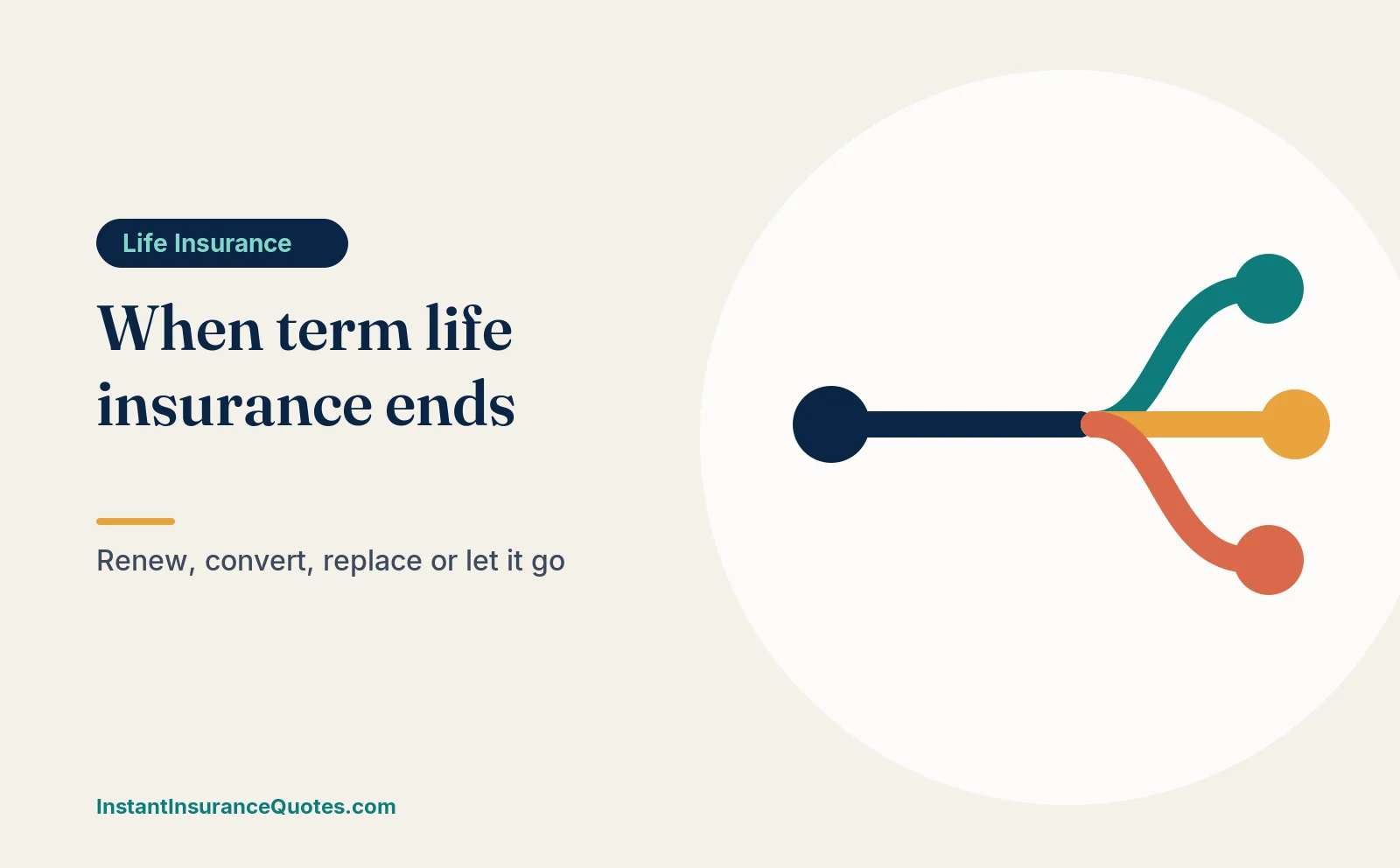
When the level term period ends, you generally have five paths:
| Option | What it means | Health questions? | Typical cost effect |
|---|---|---|---|
| Let it end | Coverage stops at the end of the term | No | Premiums stop |
| Renew | Continue the same policy, usually one year at a time, if it is renewable | Usually no | Premiums jump, often sharply, and rise each year |
| Convert | Exchange some or all of the term for a permanent policy from the same insurer | Usually no, within the conversion period | Higher premium, based on your age at conversion |
| Buy a new term policy | Apply for fresh coverage at your current age | Yes | Depends on age and health; can be cheapest if healthy |
| Exercise a return-of-premium feature | Only if you bought that rider or policy type | No | Refund of premiums paid if you outlive the term, per contract |
The NAIC Buyer's Guide notes that most term coverage can be renewed at the end of the term even if your health has changed, but that renewal premiums are higher, and it advises asking what the premiums will be and whether you lose the right to renew at a certain age. A nonrenewable policy cannot be continued; you would need to apply for new coverage.
Why renewal premiums jump
Level term policies price the full term at once, averaging the cost of insuring you over 10, 20 or 30 years. After that, many policies switch to annual renewable term pricing, which reflects the cost of insuring you for one year at your current age. That is why the bill can multiply in the first post-level year and keep rising.
| Policy year | Age | Premium (hypothetical) | What is happening |
|---|---|---|---|
| 1–20 | 35–54 | $45 a month | Level premium period |
| 21 | 55 | $520 a month | First year of annual renewable pricing |
| 22 | 56 | $570 a month | Rises each year with age |
| 25 | 59 | $760 a month | Continues to climb |
Your contract usually includes a table of maximum renewal premiums. Look for it before the term ends. Renewal is mainly useful as a short bridge, for example, to keep coverage for a year or two while applying for a new policy or while a health issue is evaluated.
How conversion works
The NAIC describes convertible term as allowing the policyholder to convert a term policy to a permanent policy that builds cash value. Its universal life buyer's guide adds that you may be able to make this trade during a conversion period "even if you are not in good health," while the premiums for the new policy will be higher than you paid for term.
Key details to find in your contract:
- Conversion deadline: often a set number of years into the policy, or an age such as 65 or 70, whichever comes first. It can end well before the term itself ends.
- Eligible products: some insurers allow conversion only to specific permanent policies, which may not be their most competitive.
- Partial conversion: many policies let you convert part of the death benefit, for example $150,000 of a $750,000 policy.
- Pricing basis: premiums are based on your age at conversion, and usually on your original health class rather than your current health.
Conversion is most valuable when your health has declined. If you developed a serious condition during the term, conversion may be the only way to keep any coverage at a standard rate.
Choosing the right path
Many people find that when a term ends, they need less coverage, not none. Common remaining needs include a partner's retirement income, final expenses, estate liquidity, a special-needs dependent or a business arrangement.
| Situation at the end of the term | Often a sensible path |
|---|---|
| Children independent, mortgage paid, solid retirement savings | Let it end |
| Good health, still need coverage for 10+ years | Apply for a new, smaller term policy before the old one ends |
| Health declined, still need coverage | Convert all or part before the conversion deadline |
| Need coverage briefly while a new policy is underwritten | Renew for a year as a bridge |
| Lifelong need, such as a dependent with a disability | Convert, or buy permanent coverage while insurable |
Do not cancel the old policy until the new one is issued and in force. A gap in coverage, even a short one, is the risk to avoid.
A timeline to start early
- Five years before the term ends: find your policy, note the level period end date, the conversion deadline and the renewal premium table.
- Three years before: re-estimate your need; see how much life insurance you need.
- Two years before: if you still need coverage and are healthy, get quotes for new term coverage. Ask the current insurer for a conversion illustration.
- One year before: decide. Start any new application early, since underwriting can take weeks.
- After the new policy is in force: stop the old one, or keep a partial conversion if that was the plan.
Grace periods, lapses and lost policies
Missing a premium can end a policy before its term does. Life policies include a grace period, commonly about 30 or 31 days, during which coverage continues after a missed payment. Some policies allow reinstatement within a set time if you prove insurability and pay back premiums. Set up automatic payments and keep your insurer's contact details current, especially as the end of the term approaches and the premium may change.
If you cannot find an old policy, the NAIC offers a free Life Insurance Policy Locator service, mainly for beneficiaries searching for a deceased person's policy.
Questions to ask your insurer
A short call or email to your insurer a few years before the term ends can answer most of the uncertainty. Ask for written answers to:
- On what date does my level premium period end, and what is the first renewal premium?
- Is my policy renewable, and to what age?
- What is my conversion deadline, and which permanent policies can I convert to?
- Can I convert only part of the death benefit, and is there a minimum amount?
- Will a conversion use my original health rating?
- Can you send an illustration for converting a specific amount, such as $100,000?
Questions readers ask
What happens when my term life insurance ends?
Coverage stops unless you renew, convert or buy a new policy. No benefit is paid if you outlive the term, unless you bought a return-of-premium feature.
Can I renew term life insurance after it expires?
If the policy is renewable, yes, usually year by year without new health questions, but premiums are much higher and rise each year. Some policies end renewal rights at a set age.
What does convertible term mean?
It lets you exchange term coverage for a permanent policy from the same insurer, generally without a new medical exam, within a conversion period stated in the contract.
Is it better to convert or buy a new policy?
If you are healthy, a new term policy is often cheaper. If your health has declined, conversion may keep coverage that you could not otherwise get at a reasonable price.
Do I get my money back if I outlive term life insurance?
Not with standard term. Return-of-premium policies refund premiums under specific conditions but cost more upfront.
Sources and further reading
Sources checked October 25, 2026. Figures are the latest published by each source at that date.
- NAIC Life Insurance Buyer's Guide (renewable vs. nonrenewable term)
- NAIC: Life insurance consumer topic (renewable, convertible and level term definitions)
- NAIC Life Insurance Buyer's Guide, universal life edition (conversion period)
- NAIC Life Insurance Policy Locator
General educational information, not advice for your situation. Policy wording, state law and the insurer's decision control actual coverage. Written and edited by K.R. Not reviewed by a licensed insurance agent; confirm details with a licensed professional or your insurer. Examples use hypothetical figures unless a source is named. Report a correction.
Use our worksheet to compare premiums, deductibles, and coverage differences. Your entries stay in this browser tab.
Open the quote comparison worksheetLife insurance: sponsored quote partners
Independent companies. We may be paid when you visit or apply. Not a ranking or a full list of the market.
Explore health, life and Medicare plan options with a licensed marketplace.
Get quotes at InsuranceMarket →Sponsored · Affiliate linkRates, eligibility and coverage are set by each provider. Read its terms and privacy policy before applying. How we earn money.