Insurance documents use a vocabulary of their own. This glossary defines 61 terms you are most likely to meet when buying or claiming on renters, homeowners, car, pet and term life insurance, in plain English, with a link to the guide that explains each one in depth.
Definitions here are general. Your policy defines its own key terms, usually in a "Definitions" section near the start, and those definitions control your coverage. When a word in your policy appears in bold or quotation marks, look it up there first.
How to use this glossary
Three habits make policy language easier to read:
- Start with the declarations page. It tells you which coverages you bought, their limits and deductibles. See our declarations page guide.
- Read the insuring agreement, then exclusions, then conditions. What is covered, what is taken away, and what you must do.
- Check endorsements last. They can add or remove coverage and override the base form.
Terms A–C
- Actual cash value (ACV)
- A way of valuing a loss: the cost to repair or replace property minus depreciation for age and wear, or what similar used property sells for. Contrast with replacement cost. Read the guide →
- Additional insured
- A person or business added to someone else's policy so they receive some of its protection, often for liability. Broader than an interested party.
- Additional living expenses (ALE)
- Extra costs of living elsewhere, such as a hotel and higher meal costs, after a covered loss makes your home unlivable. Part of loss of use coverage. Read the guide →
- Adjuster
- The person who investigates a claim and estimates what the policy owes. May be a staff adjuster, an independent adjuster hired by the insurer, or a public adjuster you hire. Read the guide →
- Annual limit
- The most a policy pays in a policy year. Common on pet insurance. Read the guide →
- Appraisal clause
- A policy provision for settling disagreements about the amount of a property loss using two appraisers and an umpire. Read the guide →
- At-fault state
- A state where the driver who causes an accident is responsible for the resulting damages, usually through liability insurance. Arizona is an at-fault state. Read the guide →
- Beneficiary
- The person or entity named to receive a life insurance death benefit. Read the guide →
- Binder
- Temporary written proof of coverage issued before the full policy, often requested by mortgage lenders at closing. Read the guide →
- Bodily injury liability
- Auto or home coverage that pays others' medical costs, lost wages and legal claims when you are responsible for injuring them.
- Claim
- A formal request to an insurer for payment under a policy.
- CLUE report
- A Comprehensive Loss Underwriting Exchange report listing past insurance claims on a person or property, used by insurers in pricing. Read the guide →
- Coinsurance
- In health insurance, your percentage share of costs after the deductible. In property insurance, a clause requiring you to insure to a set percentage of value or share in losses. Read the guide →
- Collision coverage
- Auto coverage that pays to repair your car after it hits another vehicle or object, regardless of fault, minus a deductible. Read the guide →
- Comprehensive coverage
- Auto coverage for damage not caused by a collision, such as theft, hail, fire, flood or hitting an animal, minus a deductible. Read the guide →
- Conversion privilege
- The right to exchange a term life policy for permanent coverage without new health questions, within a period stated in the contract. Read the guide →
Terms D–G
- Declarations page
- The summary page of a policy listing who and what is insured, coverage limits, deductibles, premium and endorsements. Read the guide →
- Deductible
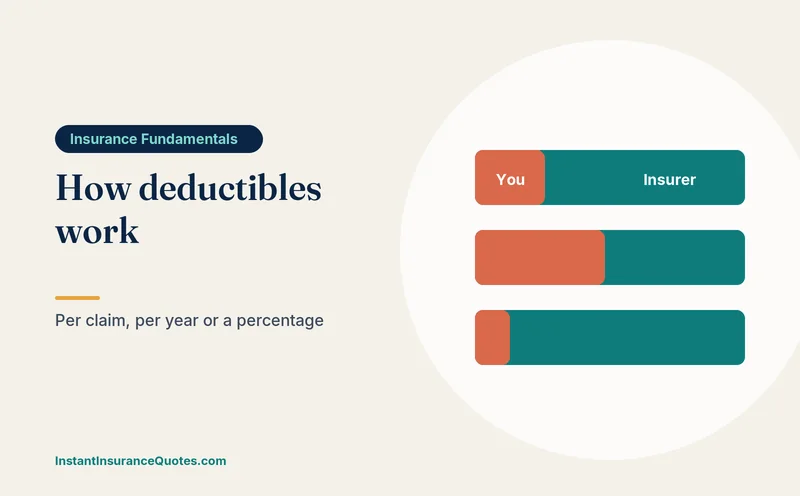
- The part of a covered loss you pay before the insurer pays. May apply per claim, per year or as a percentage of insured value. Read the guide →
- Depreciation
- The reduction in value from age, wear and obsolescence. Subtracted in actual cash value settlements. Read the guide →
- Diminished value
- The loss in a vehicle's market value after an accident, even when properly repaired. Sometimes recoverable from the at-fault driver's insurer. Read the guide →
- Dwelling coverage (Coverage A)
- Homeowners coverage for the house itself and attached structures. Read the guide →
- Endorsement (rider)
- A written change to a policy that adds, removes or modifies coverage. Read the guide →
- Escrow account
- An account your mortgage servicer uses to collect and pay property taxes and insurance premiums. Read the guide →
- Exclusion
- A provision listing what a policy does not cover. Read the guide →
- Extended replacement cost
- Home coverage that pays above the dwelling limit, such as 25% more, if rebuilding costs exceed it. Read the guide →
- Force-placed insurance
- Insurance a mortgage servicer buys and charges you for when your own coverage lapses. Usually costlier and protects mainly the lender. Read the guide →
- Free look period
- A window after receiving a policy, such as 15 days for pet insurance under the NAIC model act, to return it for a full refund. Read the guide →
- GAP insurance
- Coverage for the difference between what you owe on a car loan or lease and the car's actual cash value if it is totaled or stolen. Read the guide →
- Grace period
- Time after a missed premium due date during which coverage stays in force. Read the guide →
Terms H–O
- HO-3
- The most common homeowners policy form: open-perils coverage for the house and named-perils coverage for belongings. Read the guide →
- HO-4
- The standard renters (tenant) policy form, covering belongings, loss of use and liability but not the building. Read the guide →
- HO-6
- The condominium unit-owner policy form.
- Insurable interest
- A financial stake in the person or property insured, required to buy a policy.
- Interested party
- A person, often a landlord, who is notified if your policy is cancelled but receives no coverage under it. Read the guide →
- Level term
- Term life insurance with a death benefit and premium that stay the same for the term, typically 10, 20 or 30 years. Read the guide →
- Liability coverage
- Pays claims and legal defense when you are legally responsible for injuring someone or damaging their property.
- Limit
- The maximum the insurer will pay for a covered loss or coverage.
- Loss of use (Coverage D)
- Homeowners and renters coverage for additional living expenses when a covered loss makes your home unlivable. Read the guide →
- Medical payments coverage
- Pays small medical bills for injured guests (home) or occupants (auto), regardless of fault, up to a low limit.
- Named perils
- Coverage only for causes of loss listed in the policy, such as fire or theft. Read the guide →
- Open perils
- Coverage for all causes of loss except those excluded. Also called all-risk or special form. Read the guide →
- Out-of-pocket maximum
- In health insurance, the most you pay for covered care in a year before the plan pays 100%. Read the guide →
Terms P–S
- Percentage deductible
- A deductible equal to a percentage of the dwelling limit, common for wind, hail and hurricane. Read the guide →
- Personal property (Coverage C)
- Coverage for your belongings in a home or renters policy. Read the guide →
- Pre-existing condition
- In pet insurance, a condition with signs, treatment or veterinary advice before coverage began or during a waiting period; typically excluded. Read the guide →
- The price you pay for insurance, monthly or for the policy term.
- Proof of loss
- A sworn statement of the amount and details of a claim, often required within a set time after the insurer requests it. Read the guide →
- Reimbursement rate
- In pet insurance, the percentage of covered costs the plan pays after the deductible, such as 80%. Read the guide →
- Renewable term
- Term life insurance that can be continued after the term without new health questions, usually at higher premiums. Read the guide →
- Replacement cost
- A way of valuing a loss: the cost to replace damaged property with new property of like kind and quality, without depreciation. Read the guide →
- Scheduled personal property
- An endorsement listing specific valuable items, such as jewelry, with agreed values and broader coverage. Read the guide →
- Special limits
- Lower caps within personal property coverage for categories such as cash, jewelry theft or firearms. Read the guide →
- Subrogation
- An insurer's right, after paying you, to recover the money from the party responsible for the loss. Read the guide →
Terms T–Z
- Term life insurance
- Life insurance for a set period that pays a death benefit only if the insured dies during the term. Read the guide →
- Total loss
- When repair costs approach or exceed a property's value, so the insurer pays its value instead of repairing it. Read the guide →
- Umbrella policy
- Extra liability coverage above your home and auto limits, often in $1 million increments.
- Underwriting
- The insurer's process of evaluating risk to decide whether to offer coverage and at what price.
- Uninsured / underinsured motorist coverage
- Pays for your injuries, and in some policies car damage, when the at-fault driver has no or too little insurance. Read the guide →
- Waiting period
- Time after a policy starts before some coverage begins. Under the NAIC pet model act, up to 30 days for illness and none for accidents. Read the guide →
- Water backup coverage
- An endorsement for damage from water backing up through sewers or drains or a failed sump pump. Read the guide →
- Wellness plan
- A program or add-on that pays set amounts for routine pet care. Standalone wellness programs are not insurance. Read the guide →
Questions readers ask
What is the difference between a limit and a deductible?
The limit is the most the insurer pays; the deductible is what you pay first on a covered property claim.
What does 'peril' mean?
A cause of loss, such as fire, theft or windstorm. Named-perils policies cover only listed causes; open-perils policies cover everything not excluded.
What does 25/50/15 mean on a car policy?
Bodily injury liability of $25,000 per person and $50,000 per accident, and $15,000 of property damage liability. These are Arizona's minimums.
Where do I find my policy's definitions?
In the policy form, usually in a Definitions section. Terms defined there often appear in bold or quotation marks throughout the policy.
Sources and further reading
Sources checked October 25, 2026. Figures are the latest published by each source at that date.
- NAIC consumer glossary
- HealthCare.gov glossary
- Sample renters policy form CHO-6004 (definitions section), filed with the Nevada Division of Insurance
- NAIC Pet Insurance Model Act (definitions)
- Arizona DIFI: Auto insurance minimum coverage
General educational information, not advice for your situation. Policy wording, state law and the insurer's decision control actual coverage. Written and edited by K.R. Not reviewed by a licensed insurance agent; confirm details with a licensed professional or your insurer. Examples use hypothetical figures unless a source is named. Report a correction.
Use our worksheet to compare premiums, deductibles, and coverage differences. Your entries stay in this browser tab.
Open the quote comparison worksheet