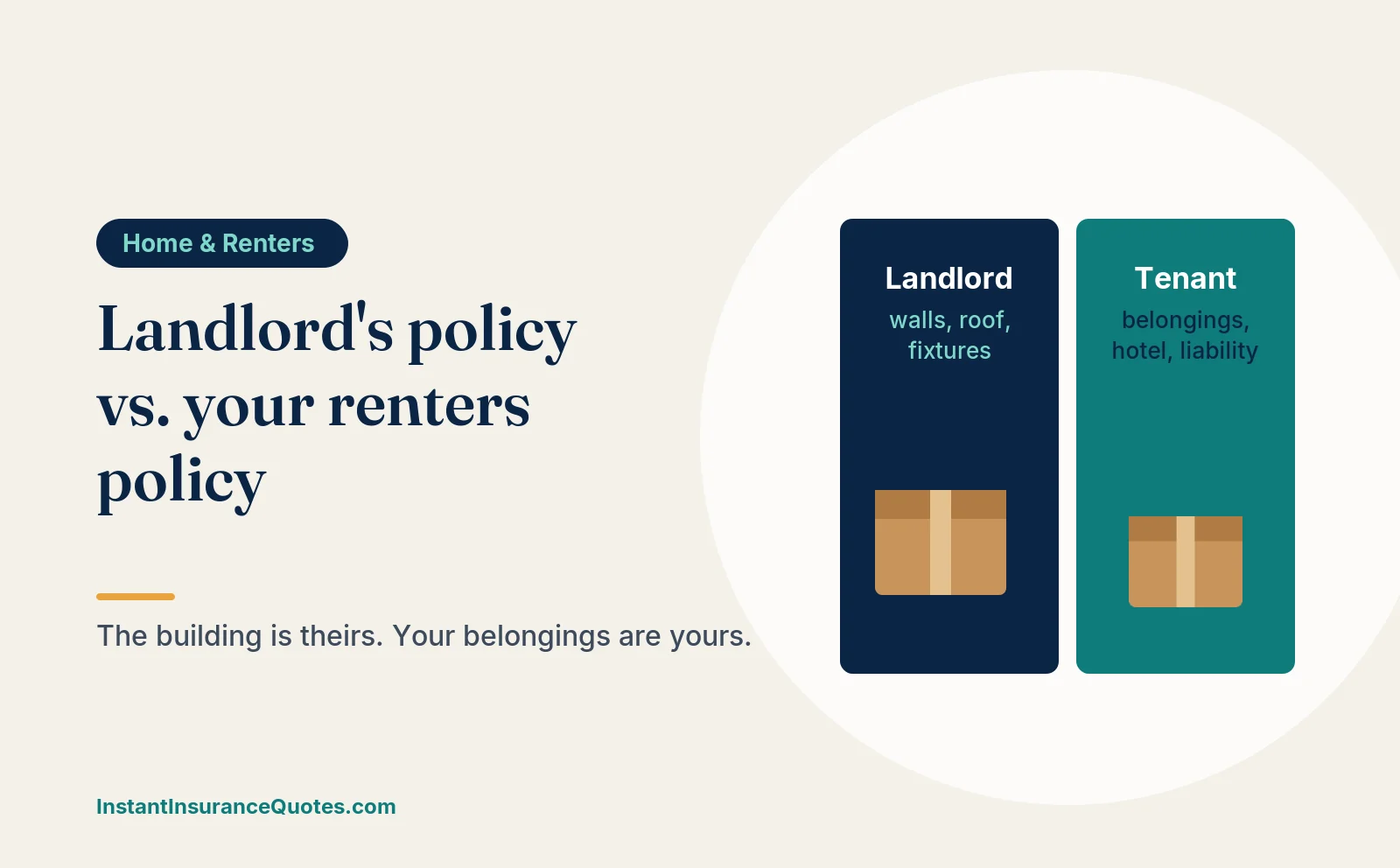
"My landlord has insurance, so I'm covered" is one of the most expensive assumptions a tenant can make. A landlord's policy and a tenant's renters policy are written for two different people with two different interests. The landlord insures the building and the landlord's own legal liability. The tenant's renters policy insures the tenant's belongings, the tenant's extra living costs after a covered loss, and the tenant's own liability.
This guide lays the two side by side, walks through common scenarios such as a kitchen fire, a burst pipe and a break-in, and explains what tends to decide who pays. It uses Arizona's landlord-tenant law as a reference point because that is where many of our readers rent; other states have similar rules but the details differ.
The two policies side by side
| Landlord's policy | Tenant's renters policy (HO-4) | |
|---|---|---|
| Who it protects | The property owner | The tenant named on the policy (and resident family) |
| The building, walls, roof, built-in fixtures | Yes | No (a small allowance for tenant improvements may apply) |
| Appliances the landlord supplied | Usually yes | No |
| Tenant's furniture, clothes, electronics | No | Yes, up to the personal property limit |
| Hotel and extra costs if the unit is unlivable | No (the landlord may have lost-rent coverage for their own income) | Yes, under loss of use |
| Lawsuit against the owner, e.g. a broken common-area stair | Yes, landlord liability | No |
| Lawsuit against the tenant, e.g. tenant's tub overflows into the unit below | No | Yes, personal liability |
| Typical policy forms | Dwelling fire (DP) or landlord package for small rentals; commercial property for apartment complexes | HO-4 tenant form |
The NAIC tracks these policy types separately. In its report on 2023 data, the HO-4 tenant form averaged $173 a year nationally. Dwelling fire policies, which many small landlords use for rental houses, cover the structure but are a different product from the tenant's policy.
What decides who pays
Insurance follows the lease and the law. In Arizona, the Residential Landlord and Tenant Act requires a landlord to "make all repairs and do whatever is necessary to put and keep the premises in a fit and habitable condition," and to maintain the plumbing, electrical, heating and air-conditioning facilities the landlord supplies (A.R.S. § 33-1324). Tenants, in turn, must keep their unit clean and safe and must not deliberately or negligently damage the premises (A.R.S. § 33-1341).
That split explains most claims:
- The building is the owner's asset. Damage to the structure is generally repaired by the landlord, who may claim on their own policy.
- Your belongings are your asset. Even when the landlord is at fault, getting paid for your property from the landlord means proving negligence, which can take months. Your renters policy pays you under your own contract, and your insurer may later pursue the landlord.
- Liability follows fault. If you cause damage to the building or a neighbor's unit, the landlord's insurer may pay the landlord and then seek repayment from you (subrogation). Your renters liability coverage is what responds to that demand.
Common rental scenarios
The table below shows how responsibility typically splits in common situations. It is a general pattern, not a promise; exclusions, the lease and the facts matter.
| What happened | Building repairs | Your belongings | Hotel costs | Notes |
|---|---|---|---|---|
| Fire starts in your kitchen while you cook | Landlord's insurer, which may seek repayment from you | Your renters policy | Your renters policy (loss of use) | Your liability coverage may respond to a subrogation claim |
| Fire starts in a neighbor's unit | Landlord's insurer | Your renters policy | Your renters policy | Your insurer may pursue the neighbor or their insurer |
| Pipe in the wall bursts | Landlord | Your renters policy (sudden water discharge is a common covered peril) | Your renters policy if the unit is unlivable | Gradual leaks you ignored may be excluded |
| Break-in through your front door | Landlord fixes the door; may charge you if lease says so | Your renters policy (theft) | Usually none | File a police report; insurers typically require one for theft |
| Your guest slips on your spilled drink inside your unit | None | None | None | Your medical payments or liability coverage |
| A visitor falls on a broken common-area stair | Landlord | None | None | Landlord's liability coverage |
| Flash flood enters a ground-floor unit | Landlord's flood policy, if any | Not covered by a standard renters policy | Usually not covered | A separate contents flood policy is available through the NFIP |
A pattern stands out: in almost every case where you lose belongings or have to move out, the landlord's insurance does not pay you directly. That is the job a renters policy is designed for.
Lease insurance requirements
Many leases require renters insurance. Typical lease language asks for:
- A minimum personal liability limit, commonly $100,000 or $300,000.
- Proof of coverage before move-in and at each renewal.
- The landlord or management company listed as an interested party or additional interest, so they receive notice if the policy is cancelled.
- Occasionally, the landlord listed as an additional insured, which is different and broader; ask your insurer whether it can be done and what it changes.
Some properties offer a "tenant liability waiver" or a master policy you can opt into for a monthly fee. These programs often protect only the landlord's building against damage you cause, and may provide no coverage for your own belongings or hotel costs. Read what the program covers before treating it as a substitute for renters insurance.
Houses, rooms, condos and short-term rentals
Renting a room, a duplex or a single-family house can blur the lines:
- Renting a house from an individual owner: the owner should carry a landlord (dwelling) policy, not a regular homeowners policy, once the home is rented out. That is between the owner and their insurer, but it affects whether claims for the building go smoothly.
- Renting a room in someone's home: the homeowner's policy generally covers the homeowner's household, not a boarder's belongings. A roommate or boarder needs their own renters policy.
- Short-term rentals: a vacation rental's host policy usually protects the host. Your own renters or homeowners policy may extend limited coverage to your belongings while traveling, subject to off-premises limits.
- Condo you rent from an owner: the building's master policy covers common structure, the owner's condo (HO-6) policy covers the unit's interior, and you still need your own renters policy for your belongings and liability.
Steps to protect yourself as a tenant
- Ask the landlord in writing what their policy covers and whether the lease requires renters insurance.
- Read the lease for clauses that make you responsible for damage you cause, appliance repairs or lockout costs.
- Buy renters insurance with enough liability to meet the lease and protect your savings.
- Photograph the unit at move-in, including existing damage, and email the photos to yourself and the manager.
- Report maintenance problems such as leaks in writing promptly. Under most policies, damage from a problem you knew about and ignored can be denied.
- After any loss, notify both the landlord (for the building) and your insurer (for your belongings and costs).
Questions readers ask
Can my landlord require me to buy renters insurance?
Generally yes, as a lease condition, in most states. Some states and cities regulate how it is required or whether the landlord may sell it; check your local rules.
Does the landlord's insurance cover my stuff if the landlord was negligent?
Not automatically. You would have to make a claim against the landlord, who may dispute fault. Your renters policy pays you under your own contract regardless of fault, and your insurer may pursue the landlord afterward.
Is a tenant liability waiver the same as renters insurance?
No. These programs typically protect the landlord's property against damage you cause. They often do not cover your belongings or your hotel costs after a fire.
If my apartment floods, who pays?
Flood is excluded from standard renters and landlord policies. The landlord may carry flood insurance for the building; tenants can buy contents-only flood coverage through the National Flood Insurance Program or private insurers.
Do I need to add my landlord to my policy?
Only if the lease requires it. Listing the landlord as an interested party simply notifies them if the policy lapses; it does not give them coverage.
Sources and further reading
Sources checked October 25, 2026. Figures are the latest published by each source at that date.
- Arizona Revised Statutes § 33-1324: Landlord to maintain fit premises
- Arizona Revised Statutes § 33-1341: Tenant to maintain dwelling unit
- NAIC homeowners report, data for 2023 (policy types and average premiums)
- Sample renters policy form CHO-6004, as filed with the Nevada Division of Insurance
- FloodSmart.gov: flood insurance for renters
General educational information, not advice for your situation. Policy wording, state law and the insurer's decision control actual coverage. Written and edited by K.R. Not reviewed by a licensed insurance agent; confirm details with a licensed professional or your insurer. Examples use hypothetical figures unless a source is named. Report a correction.
Use our worksheet to compare premiums, deductibles, and coverage differences. Your entries stay in this browser tab.
Open the quote comparison worksheetHomeowners insurance: sponsored quote partners
Independent companies. We may be paid when you visit or apply. Not a ranking or a full list of the market.
Compare auto, home, renters and pet insurance options from one request.
Get quotes at Truvo →Sponsored · Affiliate linkRates, eligibility and coverage are set by each provider. Read its terms and privacy policy before applying. How we earn money.