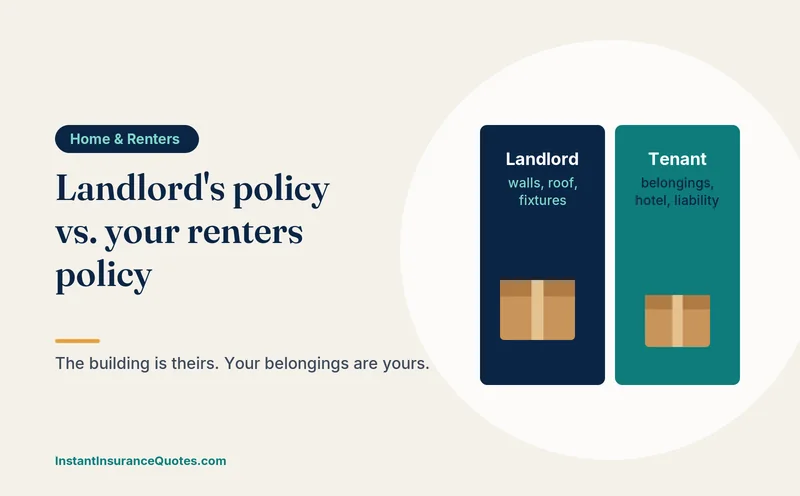
Your first apartment is usually the first time nobody else's policy is quietly covering your stuff. In a dorm or your parents' home, a family homeowners policy may have reached your laptop and bike. Once you sign your own lease, that protection usually ends or shrinks, and your landlord's insurance was never built to replace your belongings in the first place.
Renters insurance (the industry calls the standard form an HO-4) is one of the cheapest policies most people will ever buy. The National Association of Insurance Commissioners (NAIC) reports that the average renters policy in the United States cost $173 for a year of coverage in 2023, the latest year in its July 2026 report, and $166 in Arizona. This guide walks through what a first-time renter actually needs to decide: how much personal property coverage to buy, how much liability, what the deductible does, and the handful of gaps that catch new renters off guard.
What a renters policy actually covers
A renters policy is a package of four coverages. The names below follow the standard HO-4 layout; your insurer may use slightly different labels on the declarations page.
| Coverage | What it pays for | First-apartment example |
|---|---|---|
| Personal property (Coverage C) | Your belongings damaged or stolen by a covered cause, such as fire, smoke, theft, vandalism or a burst pipe | A kitchen fire ruins your couch, clothes and TV |
| Loss of use (Coverage D) | Extra living costs if a covered loss makes your unit unlivable, such as a hotel and the difference in meal costs | You stay in a hotel for three weeks while smoke damage is cleaned |
| Personal liability (Coverage E) | Claims and legal defense if you are responsible for injuring someone or damaging their property | Your overflowing bathtub leaks into the unit below |
| Medical payments to others (Coverage F) | Small medical bills for a guest hurt at your place, regardless of fault | A friend trips on a rug and needs stitches |
In one renters form filed with the Nevada Division of Insurance, loss of use pays the "necessary increase in living expenses" so your household can keep its normal standard of living, for up to 12 months, and no deductible applies to that coverage. Not every policy is worded the same way, but that structure is common and worth confirming on yours.
How much personal property coverage to buy
Most first-time renters guess too low. Furniture from a family member or a secondhand store feels worthless, but replacing it new is not. A fast way to estimate is to walk through each room with your phone and add rough replacement prices:
| Room or category | Typical items | Your estimate |
|---|---|---|
| Bedroom | Bed frame, mattress, dresser, bedding, lamp | $ |
| Closet | Clothing, shoes, coats, bags | $ |
| Living room | Sofa, TV, gaming console, rug, shelves | $ |
| Kitchen | Cookware, small appliances, dishes, food | $ |
| Electronics | Laptop, tablet, headphones, monitor | $ |
| Bathroom and misc. | Towels, toiletries, tools, bike, decor | $ |
Clothing alone surprises people. Count how many pairs of jeans, jackets and shoes you own and price a modest replacement for each. When you add it up, many single renters land between $15,000 and $35,000. That matches the market: the NAIC found that 67.1 percent of renters and condo policies in 2023 carried less than $35,000 of coverage.
The takeaway from the NAIC's averages is that the cheapest way to be underinsured is to shave coverage you need. The difference between a $20,000 and a $30,000 limit is often small in dollars per month.
Choosing a liability limit
Liability is the part of renters insurance that protects your future paychecks, and it is the coverage first-time renters think about least. If water from your washing machine ruins a neighbor's ceiling and hardwood floors, or a guest's dog bites someone in your yard and you are found responsible, the claim can far exceed the value of everything you own.
- $100,000 is a common starting limit and is what many leases ask for.
- $300,000 is often a modest price step up and makes sense if you have savings, a good income or regularly host people.
- An umbrella policy can add $1 million or more on top of renters and car liability once your assets grow; insurers usually require certain underlying limits first.
Read your lease. Many property managers require proof of renters insurance with a minimum liability limit and ask to be listed as an "interested party" or "additional interest" so they are notified if the policy lapses. Being an interested party does not give the landlord coverage under your policy; it just puts them on the notice list.
Picking a deductible
The personal property deductible is what you pay toward a covered property claim before the insurer pays. Common choices are $250, $500 and $1,000. Raising it lowers your premium, but on a policy that averages under $15 a month, the savings in dollars are modest.
A practical rule for a first apartment: choose a deductible you could pay this week without using a credit card. If a $1,000 surprise would be a crisis, the few dollars a month saved by a higher deductible are not worth it. Liability coverage and loss of use often have no deductible at all. Our guide to how deductibles work across different policies has worked examples.
Coverage gaps that surprise new renters
These are the questions that most often surprise first-time renters when they file a claim.
| Situation | Usually covered? | What to check |
|---|---|---|
| Laptop stolen from your car or a coffee shop | Often yes, as off-premises theft | Off-premises limits; the car itself is an auto insurance claim |
| Engagement ring or watch stolen | Yes, but only up to a special limit | Theft limits for jewelry, often $1,000 to $1,500 per item; schedule valuable items |
| Flooding from heavy rain or a river | No | Separate flood policy through the NFIP or a private insurer |
| Sewer or drain backup | Often excluded | Water backup endorsement |
| Your roommate's belongings | No, unless they are named on the policy | Each roommate usually buys their own policy |
| Bed bugs or pest damage | Usually excluded | Lease terms; landlord responsibilities in your state |
| Earthquake damage | No | Earthquake endorsement where available |
In the Nevada-filed renters form referenced above, theft of jewelry, watches and furs is limited to $1,500 per item and $3,000 total, money to $200, and the policy excludes flood, surface water and water that backs up through sewers or drains from outside the home's plumbing. Your insurer's limits may differ, which is why it pays to read the "special limits" section before you need it.
Actual cash value vs. replacement cost
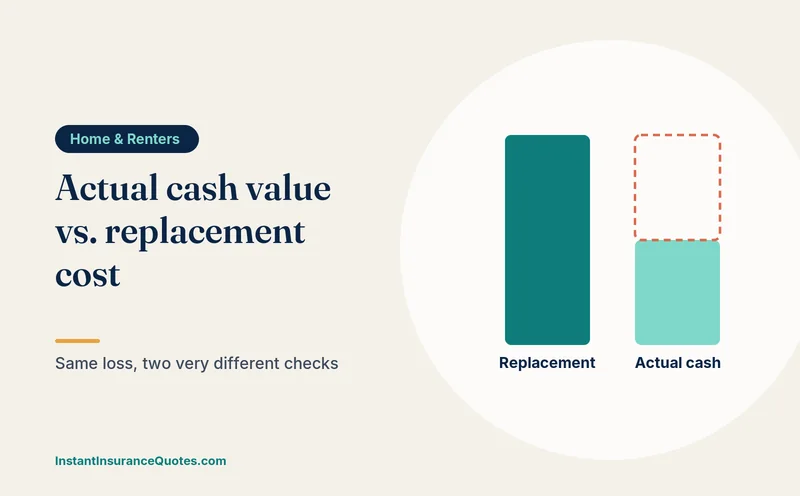
Renters policies settle personal property claims one of two ways. Actual cash value pays what the item was worth at the time of loss, after depreciation. Replacement cost pays what it costs to buy a new equivalent. For a first apartment full of items that are a few years old, the gap is large: a four-year-old laptop and a closet of worn clothes may be worth a fraction of their replacement price.
Replacement cost coverage usually adds a small amount to the premium. Many insurers pay the depreciated amount first and the rest after you actually replace the item and send a receipt. We break down the math in actual cash value vs. replacement cost.
First-apartment checklist
- Count your belongings and pick a personal property limit, rounding up.
- Choose replacement cost for personal property if the price difference is small.
- Pick a liability limit: at least what the lease requires, and consider $300,000.
- Set a deductible you could pay this week.
- List anything valuable (rings, cameras, instruments) and ask about scheduling it.
- Ask whether water backup coverage is available and what it costs.
- Add your landlord as an interested party if the lease requires it.
- Take a quick video of every room the day you move in and save receipts in a cloud folder. Our home inventory guide shows how.
- Set the policy to start on the day you get the keys, not the day you finish moving.
If you are deciding between policies, compare them on the same limits and deductible. Our quote comparison worksheet lets you line up two offers side by side in your browser.
Questions readers ask
How much does renters insurance cost for a first apartment?
The NAIC's latest national figure is $173 a year on average for 2023, about $14 a month, and $166 in Arizona. Your price depends on your ZIP code, the coverage limit, the deductible, your claims history and, in many states, a credit-based insurance score.
Is renters insurance required by law?
No state law requires it, but a landlord can require it in the lease, often with a minimum liability limit such as $100,000.
Does my parents' homeowners policy still cover me?
Possibly, but often only partly. Many homeowners policies cover a resident relative who is a full-time student living away at school, but property away from the main home is commonly limited to about 10 percent of the personal property limit. Once you sign your own lease and are no longer a student or household member, you generally need your own policy.
Can roommates share one renters policy?
Some insurers allow it, but each person usually must be named, the shared limit has to cover everyone's things, and claims affect everyone's record. Separate policies are usually cleaner.
Does renters insurance cover my car?
No. Damage to your car is an auto insurance matter. Personal belongings stolen from inside the car are often covered by renters insurance, subject to the deductible and any off-premises limits.
When should the policy start?
On the day you receive the keys. Many losses happen during a move, and a lease may require proof of coverage before move-in.
Sources and further reading
Sources checked October 25, 2026. Figures are the latest published by each source at that date.
- NAIC: Dwelling Fire, Homeowners Owner-Occupied, and Homeowners Tenant and Condominium/Cooperative Unit Owner's Insurance Report, data for 2023 (July 2026)
- Liberty Mutual renters policy form CHO-6004, as filed with the Nevada Division of Insurance (sample policy wording)
- NAIC Consumer Insight: Homeowners and renters insurance
- Insurance Information Institute: Facts and statistics, renters insurance
- FloodSmart.gov (National Flood Insurance Program): flood coverage for renters
General educational information, not advice for your situation. Policy wording, state law and the insurer's decision control actual coverage. Written and edited by K.R. Not reviewed by a licensed insurance agent; confirm details with a licensed professional or your insurer. Examples use hypothetical figures unless a source is named. Report a correction.
Use our worksheet to compare premiums, deductibles, and coverage differences. Your entries stay in this browser tab.
Open the quote comparison worksheetHomeowners insurance: sponsored quote partners
Independent companies. We may be paid when you visit or apply. Not a ranking or a full list of the market.
Compare auto, home, renters and pet insurance options from one request.
Get quotes at Truvo →Sponsored · Affiliate linkRates, eligibility and coverage are set by each provider. Read its terms and privacy policy before applying. How we earn money.