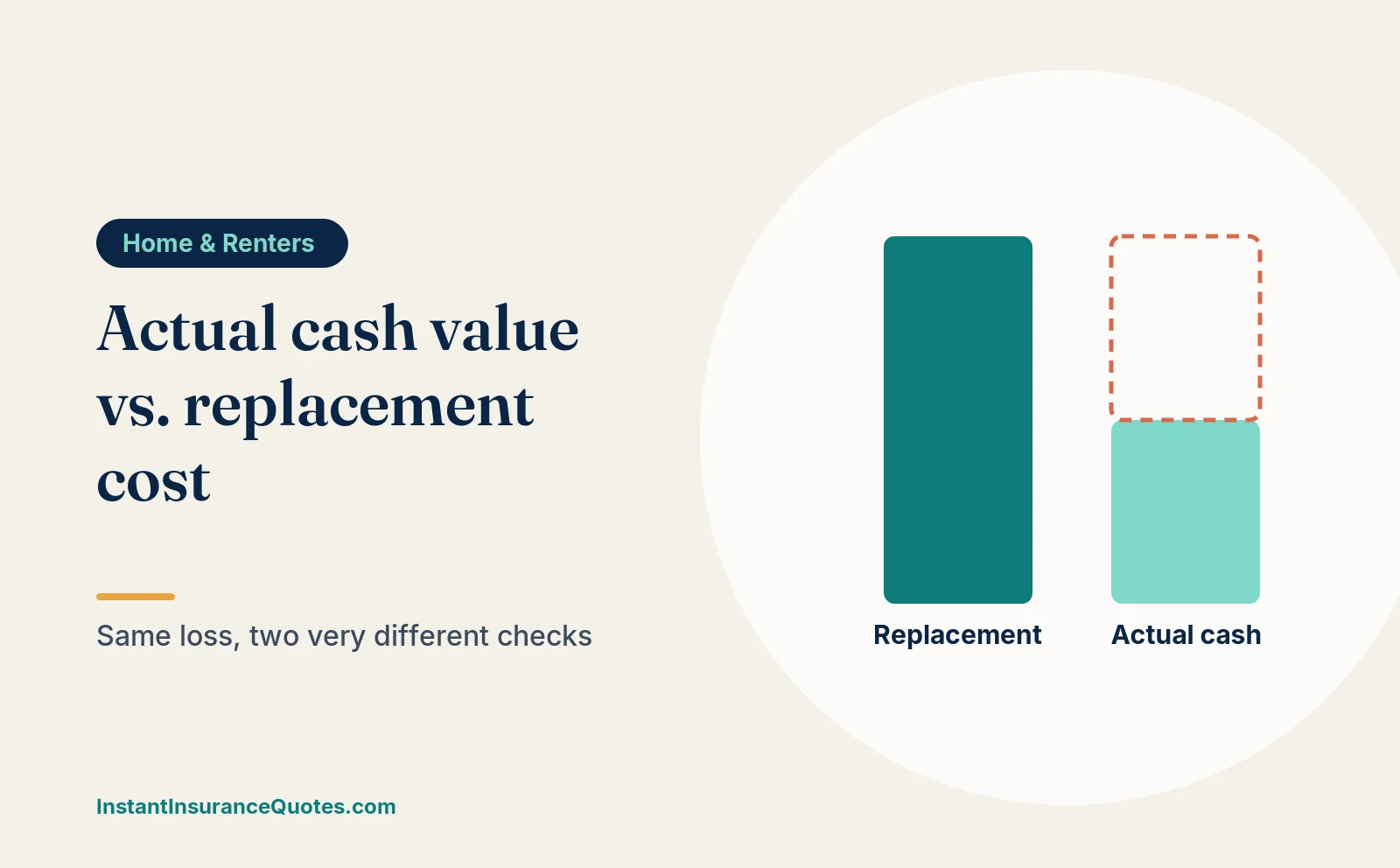
Two renters with identical belongings can file identical claims after the same kitchen fire and receive very different checks. The difference usually comes down to one line on the declarations page: whether personal property is settled at actual cash value or replacement cost.
This guide explains both methods using the definitions printed in a real policy form, shows the depreciation math step by step, explains the "holdback" that confuses many claimants, and helps you decide whether paying a little more for replacement cost makes sense for your home or apartment.
The definitions in a real policy
Policy definitions vary by insurer, so the wording in your own policy controls. As an example, one renters form filed with the Nevada Division of Insurance defines the terms this way:
- Actual cash value: when property can be repaired economically, the cost of repair "less reasonable deduction for wear and tear, deterioration and obsolescence." When it is a total loss, the market value of used property in similar condition if it is reasonably available on the used market; otherwise the price of a new equivalent less the same deductions.
- Replacement cost: for personal property, the cost at the time of loss of a new article identical to the one damaged, or a similar new article if the identical one is no longer made.
In short, actual cash value (ACV) pays for what you lost as it was, worn and aged. Replacement cost (RCV) pays for what you need to buy now to replace it new. Neither pays more than the coverage limit, and both subtract your deductible.
How depreciation is calculated
Adjusters estimate depreciation by comparing an item's age with its expected useful life and its condition. Insurers use their own depreciation tables, and they are not standardized, but the logic is usually straight-line: an item halfway through its useful life loses about half its value.
| Item | Replacement cost today | Age | Assumed useful life | Depreciation | Actual cash value |
|---|---|---|---|---|---|
| Sofa | $1,400 | 5 years | 10 years | 50% | $700 |
| Laptop | $1,200 | 3 years | 4 years | 75% | $300 |
| Winter coat | $250 | 4 years | 5 years | 80% | $50 |
| Mattress | $900 | 2 years | 8 years | 25% | $675 |
| TV | $600 | 6 years | 7 years | 86% | $86 |
| Total | $4,350 | $1,811 |
On this hypothetical claim the ACV settlement is less than half of what it costs to replace the items. Electronics and clothing depreciate fastest, which is why renters, whose belongings are mostly furniture, clothes and electronics, feel the difference most.
You can question a depreciation figure. Ask the adjuster which useful life and condition rating they used for each item, and provide evidence such as a recent purchase receipt or photos showing an item was nearly new.
The replacement cost holdback
Many replacement cost policies pay in two steps:
- First payment: the actual cash value, minus your deductible, shortly after the claim is approved.
- Second payment: the withheld depreciation (often called recoverable depreciation or the holdback) after you replace the item and send proof such as a receipt.
The policy typically sets a deadline to replace, and some limit the second payment to what you actually spent. If you replace a $1,400 sofa with a $900 one, you may recover only up to $900. If you never replace an item, you may keep only the ACV. Ask your insurer for its deadline in writing as soon as the claim opens; state rules on how long you have can differ.
The holdback is not a trick; it prevents someone from collecting the price of a new laptop for an old one they never replace. It does mean you need cash or credit to buy replacements before the second check arrives.
Replacing what a water claim damaged?
On many replacement cost policies, the withheld depreciation is paid only after the repair or replacement is done and documented. Independent retailer. We may be paid when you visit or buy. Not a ranking or a full list of the market.
An online store for bathroom remodel products: vanities with sinks, toilets, shower doors, shower bases and pans, and lighted medicine cabinets.
Browse bathroom vanities and fixtures →Sponsored · Affiliate linkA claim generally pays to repair or replace damaged property with materials of like kind and quality, so upgrades beyond that are usually your own cost. Confirm what your adjuster's estimate allows before you buy, and keep every receipt. How we earn money.
Buildings vs. belongings
The same two methods apply to buildings, and the stakes are bigger.
| Policy type | Typical settlement for the structure | Typical settlement for belongings |
|---|---|---|
| Renters (HO-4) | Not applicable (no building coverage) | ACV by default on many forms; RCV available by endorsement or as a plan option |
| Homeowners (HO-3) | Replacement cost for the dwelling if insured to the required percentage of value | Often ACV unless you add replacement cost on contents |
| Condo (HO-6) | Covers interior walls and improvements under the unit-owner policy | ACV or RCV depending on the policy |
| Landlord / dwelling fire | ACV or RCV depending on the form | Landlord's own contents only |
Mortgage lenders care about this. Fannie Mae's Selling Guide requires property insurance on one- to four-unit homes it buys loans for to settle on a replacement cost basis, with an exception for roofs, while noting that some insurers settle personal property at actual cash value. For the house itself, read our guide to replacement cost vs. market value, which explains why your dwelling limit should track rebuilding cost rather than sale price.
Roofs: the common exception
Roofs are a common exception. In many states, insurers offer or require roof coverage on a schedule that pays a declining percentage as the roof ages, or on an ACV basis once it passes a certain age. In hail-prone areas this can mean a 15-year-old roof replaced after a storm pays only a fraction of the cost. If you own a home, look for words like "roof surface payment schedule" or "actual cash value roof" on your declarations page and ask what a full roof replacement would pay today.
Which should you choose?
Replacement cost is usually the better value when:
- Your belongings are several years old, so depreciation would be steep.
- You would genuinely need to replace most of them after a fire.
- The extra premium is modest compared with the gap. On a renters policy that may be a few dollars a month.
Actual cash value can be reasonable when you own very little, your items are nearly new, or you could absorb a large loss and want the lowest premium. Even then, it is worth pricing both. Use our quote comparison worksheet to record each version.
Special cases: sets, collectibles and discontinued items
A few situations do not fit the simple depreciation formula:
- Pairs and sets. If one earring of a pair or one chair of a matched set is lost, many policies let the insurer either restore the set or pay the difference in value of the set before and after the loss, rather than the full price of a new set. The sample Nevada-filed renters form includes exactly that option.
- Items no longer made. Replacement cost is usually based on a new item of similar kind and quality, so an older phone model is replaced with a comparable current model, not necessarily the newest flagship.
- Antiques, art and collectibles. These can appreciate rather than depreciate, and standard policies may not value them fairly. Scheduling them with an appraisal on file is the reliable way to fix their value in advance.
- Items in good condition. Depreciation tables assume average wear. If an item was barely used, say so and show photos; condition is a legitimate reason to adjust the deduction.
The best protection against a lowball valuation is evidence gathered before a loss: photos or video of each room, order histories, and serial numbers for electronics. Our home inventory guide shows a fast way to build one.
Questions readers ask
Does actual cash value mean what I paid?
No. It is closer to what the item would sell for used, or the cost of a new one minus depreciation. What you paid matters only as evidence of value and age.
Can I get replacement cost without buying a new item?
Usually not the full amount. Most replacement cost policies pay actual cash value first and the withheld depreciation only after you replace the item.
Do I need receipts?
Receipts help but are not always required. Photos, bank or card statements, order histories and manuals can show what you owned and roughly when you bought it.
Is replacement cost worth it on renters insurance?
For most renters it is, because clothing, furniture and electronics depreciate quickly and the price difference is usually small. Price both options before deciding.
Does depreciation apply to labor on a home repair?
Practice varies by state and insurer. Some states restrict depreciating labor costs in ACV settlements. Ask your insurer how it calculates depreciation on a repair estimate.
Sources and further reading
Sources checked October 25, 2026. Figures are the latest published by each source at that date.
- Sample renters policy form CHO-6004 (definitions of actual cash value and replacement cost), filed with the Nevada Division of Insurance
- Fannie Mae Selling Guide B7-3-02: Property insurance requirements for one- to four-unit properties
- NAIC: Homeowners insurance consumer resources
- NAIC Consumer Insight: Homeowners and renters insurance
General educational information, not advice for your situation. Policy wording, state law and the insurer's decision control actual coverage. Written and edited by K.R. Not reviewed by a licensed insurance agent; confirm details with a licensed professional or your insurer. Examples use hypothetical figures unless a source is named. Report a correction.
Use our worksheet to compare premiums, deductibles, and coverage differences. Your entries stay in this browser tab.
Open the quote comparison worksheetHomeowners insurance: sponsored quote partners
Independent companies. We may be paid when you visit or apply. Not a ranking or a full list of the market.
Compare auto, home, renters and pet insurance options from one request.
Get quotes at Truvo →Sponsored · Affiliate linkA home warranty is a service contract, not insurance. It can cover repair or replacement of covered home systems and appliances that break down from normal wear and tear. Limits, exclusions and service fees apply.
Get a home warranty quote →Sponsored · Affiliate link · Homeowners onlyRates, eligibility and coverage are set by each provider. Read its terms and privacy policy before applying. How we earn money.